


Africa does not suffer from a shortage of opportunity. More often, the constraint is what happens after the capital arrives.
There is a familiar version of investing in Africa that begins with a promising market, a compelling founder and a financial model showing what the business could become. Capital is committed. A board is constituted. Targets are agreed.
Then the difficult part begins.
Factories still have to run. Distribution has to work. Feed has to arrive on time. Customers have to be won and retained. Working capital has to be managed. Systems have to produce reliable information. People have to make hundreds of good decisions when no investor is in the room.
At Africa Firm, this is where we believe much of the real work of investing starts.
We are interested in businesses with strong underlying economics, but we are equally interested in their ability to execute. That is why our philosophy goes beyond allocating capital. We seek to build operating companies.
Capital is necessary. Capability compounds it.
Africa Firm was established around a simple observation: many African businesses are not constrained by demand alone.
They can be constrained by production capacity, systems, governance, access to finance, routes to market, management depth or the institutional infrastructure needed to move from an entrepreneurial business to a durable company.
Closing those gaps requires more than a cheque.
Our investment approach therefore brings together three capabilities: disciplined underwriting, the relationships needed to structure and execute transactions, and operating involvement once the investment is made. The objective is not to manage businesses from a distance. It is to help create companies capable of standing on their own foundations and compounding for the long term.
You can see that philosophy reflected across the portfolio.
At Shoe Fabriek, the thesis becomes a factory floor
Ghana has a substantial market for footwear, but much of that demand has historically been met by imports. Ghana Investment Promotion Centre research on the manufacturing sector identified textiles and footwear among significant import categories, including substantial imports of rubber and textile footwear.
Shoe Fabriek approaches that gap as an operating problem.
Its Ghanaian manufacturing facility produces security boots, safety footwear, school shoes and casual footwear. The company says its installed infrastructure is capable of producing up to 800 pairs across different models per day, serving Ghanaian, African and international markets.
The strategic question is therefore larger than whether consumers need shoes. They already do.
The question is whether production can be local, consistent, competitive and scalable.
That requires machinery, skilled labour, raw-material management, quality assurance, distribution and disciplined commercial execution. It is exactly the type of opportunity where operational capability matters as much as financial capital.
At Akro Farms, efficiency is part of the investment case
Agriculture presents the same lesson in a different form.
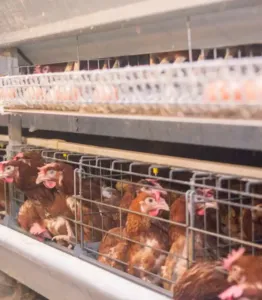
Akro Farms operates in Ghana’s poultry industry from Apasare-Adawso in the Eastern Region. Its public profile describes an integrated, automated poultry operation producing eggs, chicks, feed and meat, with technology built into the production model. It also works with farmers through an out-grower system for maize and other feed components.
The business was designed around scale and efficiency.
An earlier account of the farm’s development describes the decision to invest in automated production technology and highlights feed management, direct relationships with maize farmers, operating systems and corporate governance as central to the economics of poultry production.
That distinction matters.
Food security is often discussed as a macroeconomic problem. On the ground, however, it becomes a series of operational questions: What does feed cost? How efficiently is it converted? What is mortality? How reliable is production? Can supply remain consistent? How much of the value chain can be controlled locally?
Those questions are not solved by capital markets alone.
They are solved inside the business.
At Indigo Textiles, local production meets local identity
Indigo Textiles demonstrates another part of the same thesis.
The company produces customised fabrics for churches, schools, corporates, funerals, institutions, events and associations. Its current offering includes digital printing and customised designs, positioning the business around both manufacturing capability and highly specific local demand.
This is important because Africa’s industrial opportunity is not simply about reproducing what already exists elsewhere.
Competitive businesses can be built around an understanding of local culture, buying behaviour and institutional demand that an offshore supplier cannot easily replicate.
A school fabric is not simply cloth.
A church print is not simply cloth.
A company’s Friday wear is not simply cloth.
Each carries identity, belonging and context. Building the manufacturing capability close to that demand creates an opportunity to capture more of the value locally while responding more quickly to the customer.
Ownership should change what happens inside the company
We do not believe ownership should be a passive legal condition.
Where Africa Firm can add value, our role should be visible in the quality of the company that emerges: stronger financial controls, better information, clearer governance, more disciplined capital allocation, stronger routes to market and the management capacity required for the next stage of growth.
This is also why we are drawn to green and early-brown-stage businesses.
They are often beyond the point where the idea itself needs proving, but not yet at the institutional scale their markets could support. That gap — between demonstrated demand and institutional capability — is where operating involvement can be particularly valuable.
A portfolio should become more capable together
There is another advantage to operating across multiple businesses.
The same challenges appear repeatedly.
Manufacturers need better data. Agricultural businesses need stronger procurement systems. Growing companies need financial controls. Real-estate projects need disciplined capital structures. Consumer businesses need routes to market. Every company eventually needs better technology, stronger governance and people capable of managing complexity.
Africa Firm’s portfolio extends across agriculture, manufacturing, textiles, technology, media, real estate, strategic commodities and education. The sectors differ, but many of the operating disciplines are shared.
That creates the potential for knowledge to travel across the group.
A process improved in one company can inform another. A finance capability built once can become a standard. Technology developed around a recurring resource problem can have applications elsewhere in the portfolio.
The result we are pursuing is not simply a collection of investments.
It is an operating platform.
The return is made in the work
Investment is often presented as the moment of selection: finding the right market, the right asset and the right price.
Selection matters.
But businesses do not become valuable because they appeared attractive in an investment memorandum.
They become valuable because, after the transaction closes, somebody still has to build.
That is the part we are interested in.
We do not just fund businesses. We back operators, strengthen companies and stay close enough to the work to help turn an investment thesis into an operating result.
That is what ownership means to us.
Beyond profit. Into the work that creates it.
Maecenas facilisis egestas lacus eu
Donec rutrum nibh quis molestie blandit. Suspendisse id nisi at enim imperdiet convallis. Donec sodales tellus et leo sagittis, eu consectetur turpis porta. Phasellus diam quam, ullamcorper ut mattis varius, interdum vitae augue. Vestibulum pulvinar massa libero. Praesent ultrices dignissim tortor quis tincidunt. Vestibulum ac dignissim nibh.